 Skip to content
Healthcare Warehouse Training That Prevents Care Delays
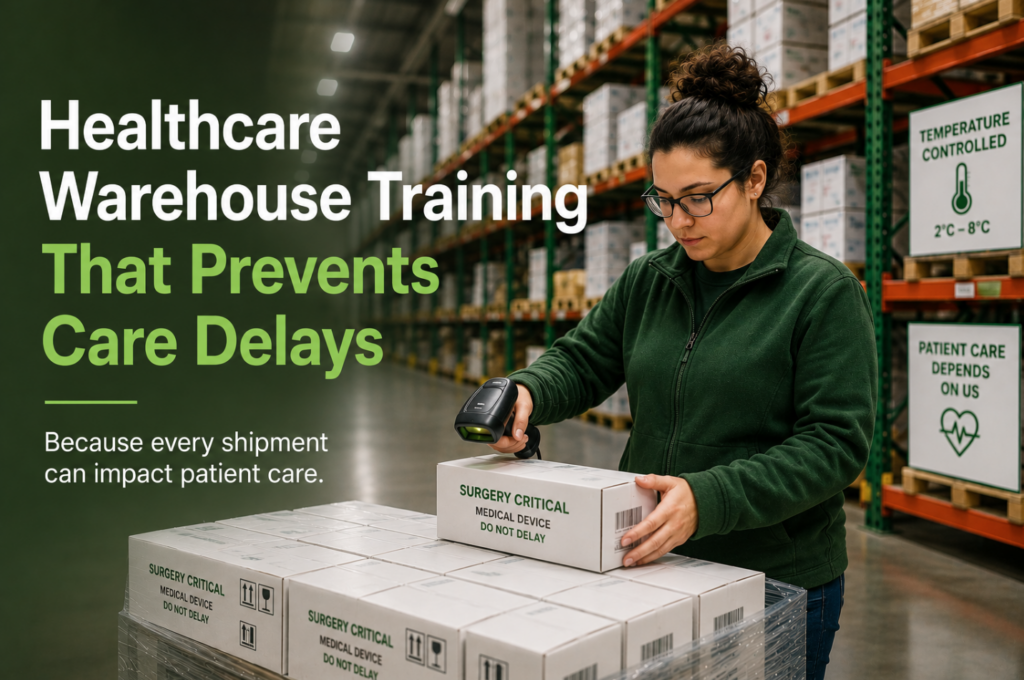
The OR schedule at Regional Medical Center showed a 7 AM cardiac procedure. The surgeon arrived. The patient was prepped. But the specialized catheter sat 200 miles away in a warehouse because the night supervisor didn’t understand “surgery-critical” meant exactly that.
Healthcare warehouse management team training isn’t about moving boxes faster. It’s about understanding that every decision affects patient outcomes. When warehouse teams grasp this connection, everything changes.
This article breaks down why healthcare warehouses succeed through trained supervisors, engaged teams, and clear expectations that connect daily tasks to patient safety. You’ll learn the specific training approaches that prevent compliance failures and delivery delays that disrupt patient care.
Why Healthcare Warehouse Teams Fail (And It’s Not the WMS)
Your warehouse management system executes perfectly. It tracks inventory, generates pick lists, and maintains chain of custody documentation. Yet patients still face supply delays, hospitals still experience stock-outs, and compliance audits still uncover gaps. The WMS isn’t the problem. Your people are.
Healthcare warehouse management failures trace back to three root causes: supervisors who manage tasks instead of teams, employees who follow procedures without understanding their purpose, and expectations that focus on metrics instead of outcomes.
When night shift supervisors don’t understand that “surgery-critical” designation means a specific cardiac procedure happens at 7 AM, they make logical decisions that produce catastrophic results. They prioritize “urgent” shipments based on volume rather than clinical need. They delay restocking because the system shows adequate inventory without recognizing that three cases of the same product are scheduled for the same morning.
The Supervisor Problem: Managing People vs. Managing Tasks
Healthcare warehouse supervisors traditionally advance from picking and packing roles based on speed and accuracy metrics. They’re excellent at executing tasks. They’re often unprepared to lead teams through the complexity of healthcare supply chains.
Task-focused supervisors create compliance risks. They enforce procedures rigidly without understanding why those procedures exist. When situations fall outside documented protocols, they either improvise in ways that create audit vulnerabilities or escalate decisions that should be handled at the floor level.
People-focused supervisors understand that their job is creating conditions where their team can execute consistently. They communicate the clinical context behind priority designations. They build redundancy into shift transitions so critical information survives handoffs. They recognize that temperature excursion protocols exist because patient safety depends on product integrity, not because regulators require documentation.
The transformation from task manager to people leader requires deliberate training. It doesn’t happen through experience alone.
Engagement: Why “Follow the SOP” Isn’t Enough
Standard operating procedures exist because someone, somewhere, made a mistake that harmed a patient or triggered a recall. Every SOP tells a story. When warehouse teams understand that story, compliance transforms from burden to purpose.
Engaged warehouse teams ask questions when situations don’t match their training. Disengaged teams follow the letter of procedures while missing their intent. This distinction becomes critical during exceptions, emergencies, and the inevitable situations that SOPs don’t fully address.
Building engagement in healthcare warehouse environments requires connecting individual tasks to patient outcomes. Pickers need to understand that the implant they’re pulling for a same-day surgery isn’t just a SKU with a quantity. Receiving teams need to know that the temperature log they’re completing could prevent a recall that harms patients months from now.
This connection doesn’t happen automatically. It requires supervisors who reinforce clinical context continuously, not just during onboarding.
Clear Expectations: The Architecture of Consistent Execution
Healthcare warehouse teams fail when expectations focus on what to do rather than why it matters. “Process 95% of priority orders within two hours” is a metric. “Ensure surgical cases have their required implants 24 hours before procedure time so OR staff can confirm availability” is an expectation with built-in context.
The difference seems subtle. The execution difference is enormous. Teams working toward metrics optimize for the measurement. Teams working toward outcomes optimize for the result. When those diverge, metric-focused teams hit their numbers while patients experience delays.
Expectations also need to address the intersection of individual responsibility and team accountability. Healthcare warehouse errors rarely result from single points of failure. They result from the accumulation of small gaps: a handoff that didn’t include a verbal confirmation, a priority flag that got cleared during system maintenance, a new employee who didn’t know to escalate an unusual situation.
Training Design: Building Healthcare Context into Warehouse Operations
Effective healthcare warehouse management training starts with clinical context. Before teaching procedures, help teams understand the healthcare supply chain they’re part of. Who are the patients depending on their work? What happens when supply chains fail? What does success look like from a clinical perspective?
This context makes subsequent procedural training meaningful. Teams who understand why temperature logs matter complete them more accurately. Supervisors who understand why priority designations exist make better decisions when situations require judgment rather than procedure-following.
Training design for healthcare warehouse management should include scenario-based learning that puts teams in situations requiring judgment. Tabletop exercises where supervisors work through exception scenarios build the decision-making capacity that SOPs can’t fully address. Case studies from actual healthcare supply chain failures create visceral understanding of consequences.
The Dircks Approach: People First, Systems Second
At Dircks, we built our healthcare logistics operations on a foundational belief: systems execute but people decide. Our warehouse management technology handles inventory tracking, compliance documentation, and chain of custody with precision. Our competitive advantage comes from the people operating those systems.
Our supervisor development program focuses on healthcare context before warehouse operations. New supervisors spend time understanding the clinical needs of the hospital systems and medical device manufacturers we serve. They learn why certain procedures exist before they learn how to enforce them.
We invest in engagement through continuous communication about outcomes. Our team knows when a shipment they handled successfully supported a critical surgery. We share that feedback because it reinforces the connection between warehouse execution and patient outcomes.
Our expectations framework focuses on outcomes rather than metrics. We track metrics to identify problems, but our teams work toward clinical outcomes that make those metrics meaningful.
Healthcare warehouse management team training isn’t a checkbox. It’s the foundation of every successful healthcare logistics operation. When trained supervisors lead engaged teams toward clear expectations, execution follows—and patients get the care they need.
Josh Proctor | Healthcare Logistics Specialist, Dircks Moving & Logistics
Related Dircks Logistics services
- Healthcare logistics for your industry
- Climate-controlled warehouse in Phoenix
- Freight distribution and last-mile delivery
- Phoenix 3PL services
Keep reading
- Healthcare Logistics Compliance: Why Shortcuts Kill Patients
- Health Product Distributors: Are You Losing Money on Deliveries?
Need warehousing, fulfillment, or distribution in Phoenix or Houston? Request a quote or call (602) 267-9401.
