 Skip to content
Scaling Storage: The Semiconductor Supply Chain's New Reality
Semiconductor demand has exploded 400% over the past five years, but most supply chain leaders are still operating with storage infrastructure designed for yesterday’s volumes. While chip manufacturers pour billions into new fabs, their supply chains remain bottlenecked by inflexible warehouse capacity that can’t scale with production cycles. The result: millions in stranded costs, proximity delays that kill just-in-time delivery, and storage conditions that destroy sensitive components in desert climates like Arizona.
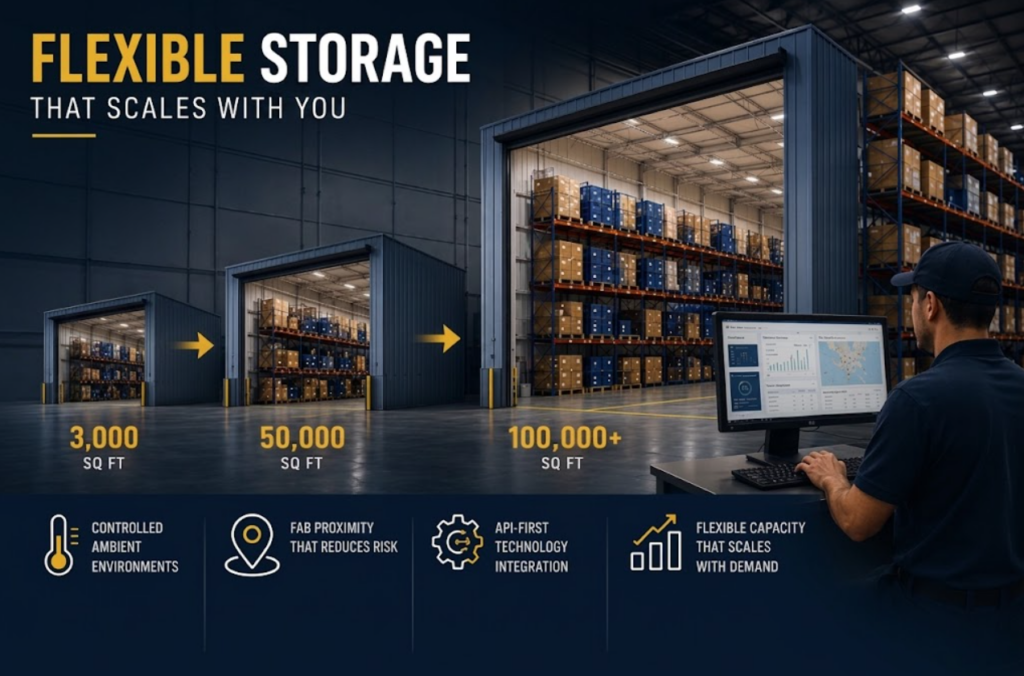
This isn’t just a capacity problem. It’s a fundamental mismatch between how semiconductors are manufactured and how they’re stored. Production cycles swing wildly based on consumer demand, yet most operations teams are locked into fixed warehouse investments that either sit empty during downturns or overflow during peaks. Smart supply chain directors are solving this with a new approach: bridge 3PL infrastructure that scales from 3,000 to 100,000 square feet without capital investment, maintains controlled ambient conditions year-round, and integrates directly with existing ERP systems.
Why Semiconductor Storage Needs Are Exploding
The numbers tell the story. Global semiconductor demand grew from $380 billion in 2019 to over $1.5 trillion in 2024, driven by AI, electric vehicles, and IoT devices. But here’s what most operations teams don’t realize: this growth isn’t linear. It comes in massive waves that can double component requirements in six months, then drop by 40% the following quarter.
Traditional warehouse investments can’t handle this volatility. A 100,000 square foot facility costs $15-25 million to build and takes 18-24 months to complete. By the time it’s operational, demand patterns have shifted. During the 2022 chip shortage, semiconductor companies were paying 300% premiums for expedited shipping because their storage infrastructure couldn’t support buffer inventory near production sites.
Fab proximity has become critical. TSMC’s Phoenix facility and Intel’s Arizona expansion represent $65 billion in local manufacturing investment. Components stored more than 30 minutes from these fabs face transportation delays that disrupt just-in-time schedules. A single delayed shipment can idle an entire production line costing $50,000 per hour.
The challenge intensifies with component sensitivity. Modern semiconductor wafers and processors require storage conditions tighter than most food products. Temperature fluctuations beyond 65-75°F can cause micro-cracking in silicon substrates. Humidity above 45% creates oxidation that renders chips unusable. Arizona’s summer temperatures regularly exceed 120°F, making controlled ambient storage essential for component integrity.
The Hidden Costs of Storage Inflexibility
Fixed warehouse investments create a cascade of hidden costs that operations teams often discover too late. During semiconductor downturns, companies pay rent on empty space while their CFOs question every line item. During booms, they scramble for overflow capacity at premium rates, often settling for facilities without proper environmental controls.
Consider the typical semiconductor component distributor managing $500 million in annual inventory. During peak seasons, they need 150,000 square feet of storage. During valleys, they use 40,000 square feet. A fixed warehouse investment forces them to pay for 150,000 square feet year-round, creating $2-3 million in annual stranded costs during slow periods.
The financial impact compounds with location. Premium locations near major fabs command $12-18 per square foot annually, but secondary locations 60+ minutes away add $200-500 per shipment in transportation costs and delivery delays. For high-volume operations making 50+ deliveries monthly, transportation penalties exceed $150,000 annually.
Variable cost structures solve this through flexible 3PL partnerships. Operations teams can scale from 10,000 to 200,000 square feet based on actual needs, paying only for space and services used. During the 2023 memory chip downturn, Dircks customers reduced their storage footprint by 60% within 30 days, avoiding millions in fixed costs while maintaining proximity to key fabs.
Integration complexity adds another layer of hidden costs. Most warehouse management systems require 6-12 months of customization to integrate with semiconductor ERP platforms like SAP or Oracle. During this integration period, companies operate with manual inventory tracking, creating errors that cost $50,000-200,000 per mistake. API-first WMS platforms eliminate these delays by connecting directly with existing systems through standard interfaces.
API-First Integration: The Bridge 3PL Advantage
Most semiconductor companies underestimate the complexity of warehouse management integration until they’re months into a failed implementation. Traditional WMS platforms were designed for simple receive-store-ship operations, not the multi-tier inventory tracking, lot traceability, and regulatory compliance that semiconductors require.
The problem starts with data structure. Semiconductor components have complex hierarchies: wafer lots, die specifications, package types, and quality grades. Each component carries dozens of attributes that must sync between warehouse systems and manufacturing ERPs. Traditional WMS platforms require extensive customization to handle this complexity, creating integration projects that drag on for 12-18 months.
API-first architecture changes this completely. Instead of custom integrations, modern WMS platforms connect through standardized interfaces that speak the same language as semiconductor ERPs. Real-time data flows both ways: manufacturing systems see exact inventory positions, while warehouse systems receive updated demand forecasts and priority changes instantly.
Dircks’ AI Cargo Towers platform exemplifies this approach. The system integrates with SAP, Oracle, and custom semiconductor ERPs through RESTful APIs that require minimal configuration. Customers typically achieve full integration within 4-6 weeks instead of 6-12 months. Real-time visibility extends across all systems, allowing production planners to see available inventory, in-transit shipments, and warehouse capacity simultaneously.
Automated exception handling becomes crucial at semiconductor volumes. Traditional systems generate hundreds of alerts daily: temperature excursions, inventory discrepancies, shipping delays. Most operations teams can’t process this volume manually, causing critical issues to slip through. API-first platforms use machine learning to prioritize exceptions automatically, escalating only issues that require human intervention.
The integration advantage extends to scalability. As semiconductor companies add new facilities, product lines, or acquisition targets, API-first systems connect new environments within days instead of months. This flexibility becomes essential as the industry consolidates and supply chains become more complex.
Controlled Ambient: Beyond Temperature Control
Arizona’s desert climate creates storage challenges that most logistics providers can’t solve properly. Summer temperatures routinely exceed 115°F with humidity below 10%, while winter nights can drop to 35°F. These extremes destroy semiconductor components through thermal cycling, moisture absorption, and electrostatic discharge.
Most warehouses attempt climate control through basic HVAC systems designed for general cargo. This creates temperature zones that vary 10-15°F across the facility and humidity swings that cause condensation during loading operations. For semiconductor components, these variations are unacceptable. Wafers exposed to temperatures above 75°F begin thermal expansion that creates stress fractures. Humidity above 45% causes oxidation that renders chips unusable within weeks.
Controlled ambient storage solves this through engineered environmental systems. Dircks operates 700,000 square feet of controlled ambient space maintaining 65-75°F year-round with humidity controlled between 35-45%. This isn’t just better air conditioning – it’s precision environmental control designed specifically for sensitive electronics.
The system uses multiple redundant HVAC zones with individual monitoring and backup power. If one zone experiences equipment failure, adjacent zones compensate automatically while maintenance teams respond. Temperature and humidity data logs continuously, providing the documentation semiconductor customers need for quality certifications and insurance claims.
Particulate control adds another critical layer. Semiconductor components attract dust and particles that can cause connection failures or performance degradation. Standard warehouse environments contain 10,000+ particles per cubic foot. Controlled ambient facilities maintain cleanroom-adjacent conditions with less than 1,000 particles per cubic foot through specialized filtration systems.
The investment in controlled ambient infrastructure pays off through reduced damage claims and extended component life. Semiconductor components stored in proper conditions maintain full performance specifications for 2-5 years. Those exposed to temperature cycling or humidity fluctuations degrade within 6-12 months, creating warranty claims that often exceed the original component cost.
Practical Takeaways for Semiconductor Supply Chain Leaders
Smart operations teams approach storage scaling differently than traditional manufacturing sectors. Start by mapping your demand volatility over 24-36 months, not just current peak requirements. Semiconductor cycles are predictable if you track leading indicators like consumer electronics launches, automotive production schedules, and data center expansion plans.
Evaluate 3PL partners based on technical capabilities, not just cost per square foot. Ask specific questions about temperature logging systems, API integration timelines, and proximity to your key delivery points. Request references from other semiconductor companies and visit facilities during Arizona summer months to verify climate control performance.
Location strategy requires balancing proximity with scalability. Being 10 minutes closer to a major fab saves $100-300 per delivery but means nothing if you can’t scale capacity during demand spikes. Look for partners offering both proximity and flexible expansion within the same facility network.
Integration planning should start with your ERP team, not your logistics team. Identify all systems that need real-time inventory data and map the specific data fields required for each integration. API-first WMS platforms can connect multiple systems simultaneously, but successful implementations require clear requirements upfront.
Risk mitigation goes beyond backup power and redundant systems. Develop contingency plans for rapid scaling both up and down. The next semiconductor downturn will happen – operations teams that can reduce storage costs quickly while maintaining critical capabilities will emerge stronger.
Quality documentation becomes crucial for semiconductor applications. Your 3PL partner should provide automated temperature and humidity logging, lot tracking, and chain of custody documentation that meets automotive and aerospace quality standards. Manual documentation creates audit risks that can shut down production lines.
The Future of Semiconductor Storage Infrastructure
The semiconductor industry is entering a new era where storage infrastructure flexibility determines competitive advantage. Companies that solve scaling challenges today will capture disproportionate value as chip demand continues growing across automotive, AI, and IoT applications.
Bridge 3PL partnerships offer the optimal solution: variable costs that match revenue cycles, controlled ambient infrastructure that protects sensitive components, and API-first integration that provides real-time visibility across complex supply chains. The most successful semiconductor companies will be those that recognize storage infrastructure as a strategic capability, not just a cost center.
Operations leaders ready to scale their storage infrastructure should evaluate partners based on technical capabilities, not just square footage and pricing. The right 3PL relationship becomes a competitive advantage that enables growth while reducing risk across volatile demand cycles.
Frequently Asked Questions
Q: How close are you to major semiconductor fabs?
A: Our 700,000 sq ft Phoenix facility is located 15 minutes from TSMC and Intel fabs, providing critical proximity for just-in-time delivery and reduced transportation risks for sensitive components.
Q: Can your warehouse management system integrate with our ERP?
A: Yes, our API-first WMS integrates directly with SAP, Oracle, and custom ERP systems. AI Cargo Towers provides real-time visibility and automated exception handling across all integrated platforms.
Q: How do you handle Arizona’s extreme temperatures?
A: Our controlled ambient storage maintains 65-75°F year-round with humidity and particulate control across our entire 700,000 sq ft facility, protecting sensitive semiconductor components from Arizona heat.
Brian Mayer | Semiconductor Logistics Specialist, Dircks Moving & Logistics
Related Dircks Logistics services
- Semiconductor logistics for your industry
- Phoenix 3PL services
- Warehousing in Phoenix
- Cross-docking in Phoenix
Keep reading
- Arizona Logistics Real Estate Boom: Chip Maker Impact
- The Supply Chain Gap Nobody's Talking About in Fab Country
Need warehousing, fulfillment, or distribution in Phoenix or Houston? Request a quote or call (602) 267-9401.
