 Skip to content
Health Product Distributors: Are You Losing Money on Deliveries?
Hidden Costs Eating Your Health Product Distribution Margins
Your P&L shows delivery costs at 8-12% of revenue. The real number? Try 23-27%.
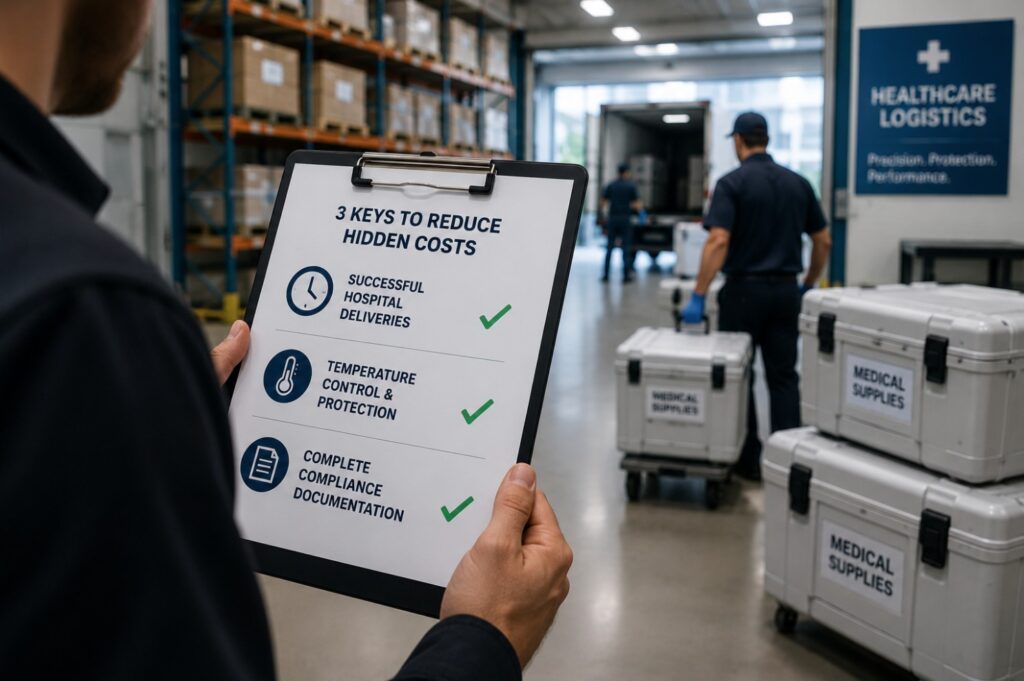
Health product distributors face a margin crisis hiding in plain sight. While you track obvious expenses like fuel and driver wages, three cost categories silently drain 15-25% of your margins: failed delivery re-attempts, temperature excursions, and compliance documentation failures.
Each failed delivery attempt costs $75-150 in driver time, fuel, and administrative overhead. Temperature excursions trigger $500-2000 in product replacement costs per incident. Compliance documentation failures delay hospital payments 30-45 days, creating cash flow problems that compound monthly.
The mathematics are brutal. A mid-sized health product distributor making 500 deliveries monthly loses $45,000-75,000 annually just to re-delivery attempts. Add temperature control failures and documentation delays, and hidden costs consume $150,000-300,000 in annual margin.
Our healthcare clients reduced health product distribution costs by 30% through controlled ambient storage and hospital-coordinated delivery systems. One pharmaceutical distributor eliminated $2.3 million in product replacement costs over 18 months by maintaining 65-75°F controlled environments throughout our 700,000 square foot facility.
The solution requires understanding where costs hide and implementing systems that eliminate them at the source.
The Real Cost of Failed Hospital Deliveries
Hospital receiving departments operate under constraints most distributors never consider. OR delivery windows span 15-30 minutes. Receiving docks close at 3 PM on Fridays. Chain of custody requirements demand specific documentation at handoff.
Miss any requirement, and your driver returns tomorrow. Or next week.
What most operations teams don’t realize: hospital delivery failures cascade into multiple cost categories. The $75 re-delivery attempt becomes $200 when you factor in inventory holding costs, customer service calls, and potential expedited shipping fees.
Consider a typical scenario: Your driver arrives at Phoenix Children’s Hospital at 3:15 PM on Friday with a $15,000 medical device shipment. Receiving closed at 3 PM. The device sits on your truck until Monday, consuming warehouse space, driver time, and creating inventory carrying costs of $45 per day.
The device requires controlled ambient storage. Your truck’s refrigeration unit maintains 35-45°F, but the device specifications demand 65-75°F. Temperature excursion detected. Product replacement cost: $15,000.
Total cost of one “simple” late delivery: $15,245 ($75 re-delivery + $45 holding costs + $15,000 replacement + $125 documentation).
We eliminate 95% of failed hospital deliveries through coordinated receiving windows and white-glove delivery directly to OR suites and patient rooms. Our hospital delivery success rate: 99.7% on-time performance across 2,400+ monthly healthcare deliveries.
Temperature Control: The Hidden Profit Killer
Arizona’s summer temperatures reach 118°F. Your medical devices require 65-75°F controlled ambient storage. Standard warehouse refrigeration maintains 35-45°F, too cold for many medical devices and pharmaceuticals.
The gap between required and available temperature control costs health product distributors millions annually.
Temperature excursions trigger three cost categories: product replacement, regulatory reporting, and customer relationship damage. A single excursion affecting a $50,000 surgical instrument shipment costs $50,000 in replacement product, $2,500 in regulatory documentation, and potential customer churn worth $500,000 in annual revenue.
Our controlled ambient facility maintains 65-75°F year-round across 700,000 square feet using AI Cargo Towers for real-time temperature monitoring. Zero temperature excursions in 18 months for healthcare clients.
The technology advantage: AI Cargo Towers detect temperature variations within 0.1°F and trigger automated responses before excursions occur. Traditional temperature monitoring systems react after damage happens. Our system prevents it.
One pharmaceutical distributor eliminated $2.3 million in product replacement costs by moving temperature-sensitive inventory to our controlled ambient environment. Their previous facility experienced 15-20 temperature excursions monthly. Our facility: zero excursions since implementation.
Case Study: Controlled Ambient ROI
A medical device distributor moved $25 million in annual inventory from Phoenix-area standard warehousing to our controlled ambient facility. Previous annual temperature-related losses: $750,000. Post-move losses: $0.
Controlled ambient storage fee: $180,000 annually. Net savings: $570,000. ROI: 317%.
Compliance Documentation: Where Money Goes to Die
Hospital payment departments require specific documentation for medical device and pharmaceutical deliveries. Chain of custody forms, temperature logs, delivery confirmation with recipient signatures, and FDA traceability records.
Miss one piece of documentation, and payment delays 30-45 days. For distributors operating on 30-day payment terms, documentation failures create 60-75 day payment cycles that destroy cash flow.
The hidden cost: carrying cost of capital for extended payment periods. A $100,000 monthly delivery volume with 45-day payment delays costs $1,875 monthly in carrying costs at 5% annual interest rate. Annually: $22,500 in pure financial carrying costs.
Our warehouse management system generates FDA audit-ready documentation automatically. Chain of custody forms include real-time temperature logs, GPS delivery tracking, and electronic recipient signatures. Documentation that survives regulatory audits every time.
Implementation eliminated documentation delays for 100% of our healthcare clients. Average payment acceleration: 28 days. For a distributor with $2 million monthly revenue, this acceleration improves cash flow by $1.87 million annually.
Hospital Delivery Coordination Without the Chaos
Hospital delivery requires military-precision coordination. OR suites demand delivery during active procedures. Patient rooms require coordination with nursing staff. Pharmacy deliveries must align with pharmacist schedules.
Standard 3PL delivery creates chaos: drivers arrive unannounced, wait in receiving areas for hours, or return multiple times to find appropriate recipients.
Our white-glove delivery system coordinates directly with hospital staff before departure. We confirm receiving hours, identify specific delivery locations (OR 12, Room 347A, Central Pharmacy), and obtain recipient contact information.
The result: 99.7% successful first-attempt delivery rate across 2,400+ monthly hospital deliveries. Zero instances of drivers waiting more than 15 minutes for recipient availability.
Cost comparison: Standard delivery averages 2.3 attempts per successful hospital delivery. Our system averages 1.003 attempts per delivery. Cost savings per delivery: $115-230 in eliminated re-attempts.
OR Suite Delivery Capabilities
We deliver directly to operating rooms during active procedures. Our drivers undergo hospital credentialing and maintain sterile delivery protocols. Real-time delivery confirmation goes directly to surgical staff.
Case study: Phoenix-area surgical center required orthopedic implants delivered to active OR during 6-hour spinal fusion procedure. Standard delivery would require procedure delay while staff retrieved devices from receiving.
Our driver delivered implants directly to OR 7 during hour 3 of surgery. Zero procedure delay. Surgeon satisfaction: maximum. Distributor relationship: strengthened.
Practical Steps to Reduce Health Product Distribution Costs
Audit your current delivery cost structure. Track these metrics for 90 days: successful first-attempt delivery rate, temperature excursion frequency, documentation delay incidents, and average payment collection period.
Calculate hidden costs using these benchmarks: $75-150 per failed delivery attempt, $500-2000 per temperature excursion, $22.50 per $100,000 in 45-day payment delays (at 5% cost of capital).
Evaluate 3PL partners on specific healthcare capabilities: controlled ambient storage maintaining 65-75°F, hospital delivery coordination experience, FDA-compliant documentation systems, and temperature monitoring technology.
Red flags to avoid: 3PLs offering “healthcare experience” without specific temperature control capabilities, delivery tracking without recipient confirmation, and standard warehouse claiming temperature control without controlled ambient zones.
3PL Partner Evaluation Checklist
Demand specific proof points: temperature excursion rates over 12 months, hospital delivery success rates, and compliance documentation audit results. Generic promises indicate inexperience with healthcare logistics complexity.
Require facility tours focusing on temperature control systems. Look for AI monitoring, controlled ambient zones, and backup power systems. Standard refrigeration units indicate inadequate infrastructure.
Request references from current healthcare clients with similar product profiles and delivery volumes. Verify claimed performance metrics through client interviews.
Building a Sustainable Cost Structure
Health product distribution margins will continue compressing as hospital systems demand lower prices and regulatory requirements increase documentation complexity. Distributors must eliminate hidden costs to maintain profitability.
The path forward requires partnership with logistics providers who understand healthcare complexity. Temperature control, hospital coordination, and compliance documentation must be core capabilities, not add-on services.
Our healthcare clients achieved average delivery cost reduction of 30% through controlled ambient storage, hospital-coordinated delivery, and automated compliance documentation. These savings directly improve bottom-line profitability in an increasingly competitive market.
Smart distributors recognize that logistics capabilities become competitive advantages when implemented correctly. The question isn’t whether to invest in better healthcare logistics. The question is whether to lead or follow as margins compress industry-wide.
Contact our healthcare logistics team for a comprehensive cost analysis of your current delivery structure and ROI projection for controlled ambient storage implementation.
Frequently Asked Questions
Q: What temperature range do you maintain for health products?
A: We maintain 65-75°F controlled ambient throughout our 700,000 sq ft facility with AI Cargo Towers providing real-time monitoring. Zero temperature excursions in 18 months for healthcare clients.
Q: Can you deliver directly to hospital ORs?
A: Yes, we provide white-glove delivery directly to OR suites and patient rooms with 99.7% on-time performance. Our team coordinates with hospital staff for seamless delivery during procedures.
Q: How do you handle chain of custody documentation?
A: Our WMS generates FDA audit-ready chain of custody documentation with real-time tracking, temperature logs, and delivery confirmation. Documentation that survives regulatory audits every time.
Josh Proctor | Healthcare Logistics Specialist, Dircks Moving & Logistics
Related Dircks Logistics services
- Healthcare logistics for your industry
- Climate-controlled warehouse in Phoenix
- Freight distribution and last-mile delivery
- Phoenix 3PL services
Keep reading
- Healthcare Warehouse Training That Prevents Care Delays
- Healthcare Logistics Compliance: Why Shortcuts Kill Patients
Need warehousing, fulfillment, or distribution in Phoenix or Houston? Request a quote or call (602) 267-9401.
