 Skip to content
Arizona Heat vs. Your Shelf-Stable Products: The $50K Solution
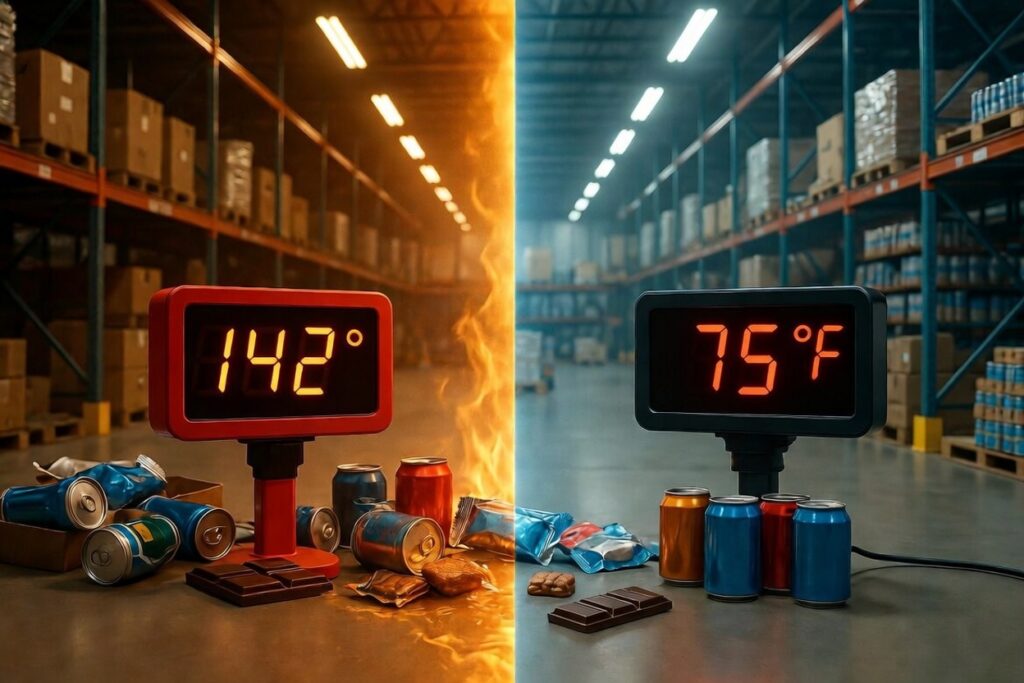

Your Phoenix warehouse hit 142°F yesterday. Your protein bars are now inedible. Your beverage cans are bulging. Your retailer is demanding a $50,000 chargeback.
This is the reality for food and beverage companies trying to operate in Arizona with traditional warehouse storage. When Phoenix temperatures soar past 120°F for months, uncontrolled warehouses become product-destroying ovens. Most operations managers think they can ride out Arizona summers with fans and prayers. They’re wrong.
The moment your Arizona warehouse temperature control food storage fails, you’re looking at massive write-offs, damaged retailer relationships, and supply chain chaos. Here’s what actually works: controlled ambient storage that maintains 65-75°F year-round, regardless of outside conditions.
Arizona Heat Destroys Shelf-Stable Products (The $50,000 Problem)
Phoenix reaches 120°F for four months straight. Traditional warehouses without proper climate control hit 140-145°F inside. Your “shelf-stable” products start degrading at 85°F. The math is brutal.
A single heat damage incident costs the average CPG company $50,000 in write-offs, chargebacks, and replacement inventory. Large beverage companies have reported losses exceeding $200,000 from a single summer heat wave.
Consider what happens to common shelf-stable products in extreme heat:
- Protein bars become rock-hard or completely melt
- Canned beverages develop off-flavors and potential safety issues
- Chocolate products bloom, melt, or become inedible
- Vitamin supplements lose potency and may become harmful
- Packaging integrity fails, creating contamination risks
The damage compounds. Retailers don’t just want refunds for damaged goods. They want chargebacks that include their labor costs, disposal fees, and margin recovery. They question your quality systems. They reduce future orders.
One Arizona beverage distributor told us they lost three major retail accounts after a single weekend when their warehouse air conditioning failed during a 118°F heat wave. The damaged inventory was $30,000. The lost business was $500,000 annually.
Traditional warehouses in Phoenix face impossible physics. Metal buildings with basic insulation become ovens. Concrete floors absorb and radiate heat for hours after sunset. Standard HVAC systems can’t keep up with Arizona’s relentless summer assault.
Why 65-75°F Controlled Ambient Changes Everything
Controlled ambient storage isn’t just air conditioning. It’s precision climate control that maintains optimal storage conditions regardless of external weather.
Our 700,000 square foot Phoenix facility maintains 65-75°F year-round through zone-specific temperature management. AI Cargo Towers monitor every section in real-time, preventing the hot spots that destroy products in traditional warehouses.
The system works because it’s designed for Arizona extremes. High-efficiency cooling systems with redundant capacity. Advanced insulation that blocks heat transfer. Automated controls that adjust before problems develop.
Most food companies don’t realize how much money they lose to temperature fluctuations beyond obvious heat damage. Products stored at inconsistent temperatures have shorter shelf lives, reduced quality scores, and higher return rates.
Controlled ambient storage for food products Phoenix operations eliminates these hidden costs. Consistent 65-75°F storage maximizes product shelf life. Real-time monitoring prevents quality degradation before it starts. Integrated WMS tracking provides full temperature chain of custody for retail compliance.
The energy efficiency surprises most clients. Our controlled ambient systems use 40% less energy than traditional warehouse cooling because they’re designed for consistent operation rather than emergency temperature recovery.
Consider Fairlife’s experience. They scaled from 3,000 to 100,000 square feet in our facility without a single heat-related product loss. Their previous Arizona storage partner had three major incidents in two years, costing over $150,000 in write-offs.
From Damaged Goods to Retail-Ready Distribution
Temperature control is just the foundation. The real competitive advantage comes from integrating controlled storage with advanced fulfillment capabilities.
Our WMS integration provides real-time temperature logging for every SKU. Retailers can access temperature history for any shipment. Quality managers can track storage conditions from receipt to delivery. This level of documentation prevents disputes and builds retailer confidence.
The operational impact is immediate. Zero heat damage claims since 2019. Faster retail replenishment cycles because retailers trust product quality. API-first WMS integration that connects with existing ERP systems without disruption.
One Phoenix CPG company reduced their product return rate from 3.2% to 0.8% simply by switching to controlled ambient storage. The improved quality scores led to expanded retail distribution and 25% revenue growth in their Arizona market.
The integration capabilities matter because food and beverage operations need more than storage. They need pick-and-pack fulfillment, retail compliance labeling, and just-in-time delivery coordination. All while maintaining perfect temperature control.
Our facility handles everything from individual ecommerce orders to full truckload retail shipments. The controlled ambient environment ensures product integrity whether you’re shipping one case or 1,000 cases.
What Smart Operations Teams Look For
When evaluating Arizona food warehouse solutions, focus on these critical capabilities:
Redundant climate control systems: Single-point failures destroy inventory. Look for facilities with backup cooling, emergency power, and automated failover systems.
Real-time monitoring: Temperature logs every 15 minutes aren’t enough. You need continuous monitoring with immediate alerts for any deviation from optimal conditions.
Scalable capacity: Growing food brands need space to expand without relocating. Evaluate facilities that can accommodate 3x growth within the same location.
Integration capabilities: Your 3PL should connect with your existing systems, not force you to adopt their technology. API-first platforms prevent operational disruption.
Red flags to avoid include facilities that promise temperature control but lack redundant systems. Any warehouse that’s had temperature failures in the past two years. 3PLs that can’t provide detailed temperature history for compliance documentation.
The Arizona market demands specialized capabilities. Generic 3PL providers who handle Arizona as just another location typically underestimate the challenges. You need partners who understand Arizona-specific requirements and have invested in Arizona-optimized infrastructure.
Consider the total cost of ownership. Cheap storage becomes expensive when you factor in write-offs, chargebacks, and lost retail relationships. Controlled ambient storage prevents these hidden costs while enabling business growth.
Building Heat-Resistant Supply Chains
Arizona represents the future of logistics challenges. Climate change means more cities will face extreme temperatures. Supply chains designed for moderate climates will fail.
Forward-thinking food and beverage companies are building heat-resistant operations now. Controlled ambient storage in strategic locations. Temperature monitoring throughout the supply chain. Quality systems that prevent problems rather than react to them.
The competitive advantage is significant. While competitors deal with heat damage and quality issues, you deliver consistent products that build retailer confidence and consumer loyalty.
Arizona’s growth continues accelerating. The companies that solve temperature control challenges now will dominate the market as competition intensifies. Those that ignore climate realities will face escalating losses and operational chaos.
Smart operations teams recognize that controlled ambient storage isn’t an expense. It’s an investment in reliable operations, retailer relationships, and business growth.
The question isn’t whether you can afford temperature-controlled storage. It’s whether you can afford not to have it. The Arizona heat isn’t getting cooler. Your products aren’t getting more heat-resistant. But your storage solutions can be bulletproof against extreme temperatures. The choice is simple: invest in proper temperature control or keep paying for heat damage.
Matt Dircks | Food & Beverage Logistics Specialist, Dircks Moving & Logistics
Related Dircks Logistics services
- Food and beverage logistics for your industry
- Climate-controlled warehouse in Phoenix
- Pick and pack fulfillment
- Warehousing in Phoenix
Keep reading
- How One Dairy Brand Grew 30x Without Changing Warehouses
- The Real Cost of Good Enough Temperature Control in Phoenix
Need warehousing, fulfillment, or distribution in Phoenix or Houston? Request a quote or call (602) 267-9401.
Frequently Asked Questions
Why do shelf-stable products fail in Arizona warehouses?
Phoenix summers are extreme, and warehouses without climate control expose inventory to sustained heat that degrades packaging and product quality.
What is controlled ambient storage?
Warehouse space held at consistent, continuously monitored conditions year-round, rather than following outside weather.
Does Dircks offer climate-controlled space in Phoenix?
Yes. Dircks provides climate-controlled and controlled-ambient storage with continuous environmental monitoring.
