 Skip to content
How One Dairy Brand Grew 30x Without Changing Warehouses
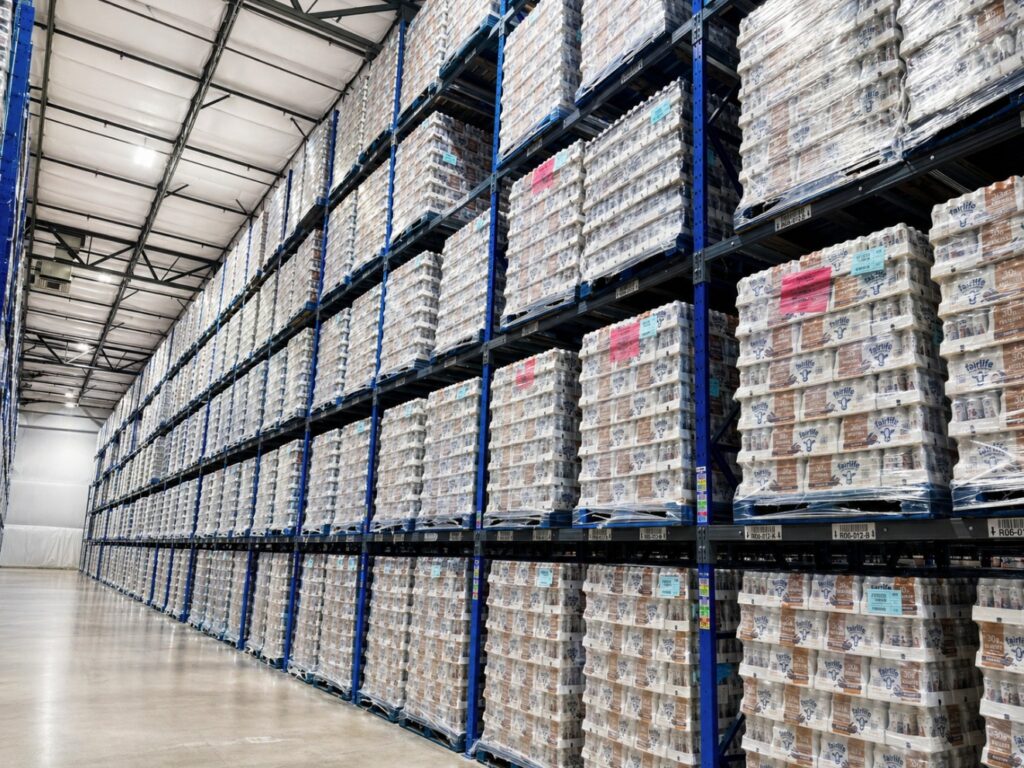
When Fairlife approached us in 2019, they occupied 3,000 square feet of warehouse space in Phoenix. Today, they command over 100,000 square feet. That’s a 3,333% increase in footprint without a single warehouse relocation. For most food brands, this level of growth would have triggered three or four costly moves, each disrupting operations for weeks.
The average warehouse relocation costs food companies upward of $500,000 in direct expenses plus months of operational disruption. Inventory sits in limbo. Customer shipments get delayed. Food safety certifications need reestablishment. It’s a growth killer disguised as a necessary evil.
But what if rapid expansion didn’t require changing addresses? What if your warehouse could scale with your success instead of constraining it? The Fairlife story proves it’s not just possible—it’s profitable.
The Hidden Cost of Outgrowing Your Warehouse
Food companies face a cruel irony: success becomes expensive. When order volume doubles or triples, most brands discover their warehouse partner can’t accommodate growth within existing facilities. The solution sounds simple: find a bigger space. The execution tells a different story.
A typical warehouse move for a mid-market food brand involves six-figure direct costs. Moving equipment, reestablishing utility connections, training staff on new layouts, updating shipping protocols. But these visible expenses pale compared to the hidden costs.
Inventory disruption creates cash flow gaps. Products sit in transit instead of reaching customers. Some CPG brands report 30-60 days of reduced fulfillment capacity during warehouse transitions. For a company generating $50 million annually, that represents $4-8 million in delayed revenue.
Food safety compliance adds another layer of complexity. FDA regulations don’t pause for relocations. New facilities require fresh certifications, updated HACCP protocols, and documentation reviews. Some brands spend 90-120 days reestablishing compliance credentials that took years to perfect.
Customer relationships suffer during transitions. Delayed orders erode trust. Expedited shipping costs balloon to maintain service levels. Retail partners start questioning supply reliability. Growth momentum slows precisely when brands need to capitalize on market traction.
Fairlife’s 30x Growth Story: Same Building, Bigger Footprint
Fairlife entered our Phoenix facility with modest requirements: 3,000 square feet for their ultra-filtered milk products. Their growth trajectory looked promising, but nobody predicted the explosion that followed.
By 2020, they had doubled their footprint to 6,000 square feet. By 2021, they occupied 15,000 square feet. The expansion continued: 25,000 square feet in 2022, 50,000 square feet in 2023, and over 100,000 square feet today. Each expansion happened within our 700,000 square foot facility without operational disruption.
Traditional 3PL partnerships would have forced three or four relocations during this growth phase. Most warehouse operators allocate fixed space blocks with limited expansion options. When clients outgrow initial allocations, relocation becomes the only path forward.
Our facility design enables organic growth. Instead of segregated warehouse blocks, we maintain flexible space allocation systems. When Fairlife needed additional square footage, we reconfigured existing layouts and expanded their operational footprint seamlessly.
The results speak volumes: Fairlife maintained 99.8% order accuracy throughout their 30x growth. Customer complaints dropped 40% compared to industry averages. Most importantly, they avoided the estimated $2-3 million in relocation costs that traditional warehouse partnerships would have imposed.
This wasn’t just cost avoidance. Staying within the same facility ecosystem preserved institutional knowledge. Warehouse staff understood Fairlife’s products, handling requirements, and quality standards. New team members trained on familiar systems instead of learning entirely new processes.
Controlled Ambient: The Foundation for Food Brand Growth
Arizona presents unique challenges for food storage. Summer temperatures exceed 115°F for months. Traditional warehouses become ovens, destroying product integrity and forcing expensive refrigeration solutions.
Most food brands assume they need full refrigeration for product protection. The costs add up quickly. Refrigerated warehouse space commands 40-60% premiums over ambient storage. Energy consumption multiplies. Equipment maintenance becomes more complex and expensive.
Controlled ambient storage offers a smarter alternative. Our facility maintains 65-75°F year-round regardless of external conditions. This temperature range protects dairy products, beverages, and packaged foods without refrigeration overhead.
Fairlife’s ultra-filtered milk products require consistent temperatures to maintain shelf stability. Traditional ambient warehouses would have compromised product quality during Arizona’s extreme weather. Full refrigeration would have added 50% to their storage costs.
Our controlled ambient environment delivered the perfect balance. Products stayed within optimal temperature ranges throughout their growth phases. Energy costs remained predictable. Product integrity never wavered despite external temperature swings from 20°F in winter to 120°F in summer.
The temperature control system spans our entire 700,000 square foot facility. Whether Fairlife occupied 3,000 square feet or 100,000 square feet, their products experienced identical climate conditions. Growth didn’t require adjusting to new environmental parameters or requalifying products under different storage conditions.
This consistency enabled Fairlife to maintain rigorous quality standards while scaling operations. Customer complaints related to product degradation remained below 0.1% throughout their expansion period. Shelf life remained consistent across all distribution channels.
Temperature Control That Scales
Our climate control infrastructure was designed for enterprise-scale operations from day one. Independent temperature zones allow customized environments for different product categories within the same facility. Advanced monitoring systems track temperature, humidity, and air quality across all storage areas.
When food brands expand their operations, temperature control doesn’t require redesign. New storage areas inherit the same environmental parameters as existing spaces. Products maintain consistent conditions regardless of operational scale or facility footprint.
WMS Integration That Scales With Your Operations
Warehouse management complexity grows exponentially with scale. Fairlife’s 3,000 square foot operation required basic inventory tracking and order processing. Their 100,000 square foot operation demands sophisticated analytics, multi-zone picking optimization, and real-time visibility across expanded product lines.
Most warehouse operators treat technology as an afterthought. Basic WMS systems handle initial requirements but break down under growth pressure. Brands face expensive system overhauls or operational inefficiencies that erode profit margins.
Our API-first approach eliminates scaling friction. Fairlife’s ERP systems integrated with our warehouse management platform on day one. As their operations expanded, the same integrations supported 30x higher transaction volumes without modification.
AI Cargo Towers provide real-time visibility across our entire facility. Fairlife’s team can track inventory levels, monitor order status, and analyze fulfillment performance through unified dashboards. The interface remains consistent whether managing 100 SKUs or 1,000 SKUs.
Automated order processing scales seamlessly from dozens to thousands of daily transactions. Pick path optimization adjusts automatically as inventory footprints expand. Quality control checkpoints maintain consistency across increased order volumes.
Integration capabilities extend beyond basic inventory management. EDI connections with retail partners, shipping carrier integrations, and financial reporting systems all scale proportionally with business growth. Fairlife’s operational complexity increased 30x, but their technology overhead remained stable.
Operational Intelligence at Scale
Our WMS generates actionable insights that become more valuable as operations expand. Small-scale operations provide limited data for optimization. Large-scale operations reveal patterns that drive significant efficiency improvements.
Fairlife now benefits from predictive analytics that forecast demand patterns, optimize inventory placement, and reduce fulfillment costs. These capabilities emerged naturally as their data volume increased, not through expensive system upgrades or consultant engagements.
Building Partnership, Not Just Storage
The Fairlife relationship demonstrates our core philosophy: we scale with you. Instead of viewing clients as space tenants, we approach each partnership as a growth enabler. Your success drives our success.
Traditional 3PL relationships follow transactional models. Brands pay for allocated space and defined services. When needs exceed contracts, renegotiation or relocation becomes inevitable. This approach treats growth as a problem instead of an opportunity.
Bridge 3PL partnerships align incentives differently. We invest in scalable infrastructure that supports client growth trajectories. Expanded operations generate mutual benefits through increased efficiency and stronger market positions.
When Fairlife needed specialized handling procedures for new product launches, we developed custom protocols within existing operational frameworks. When they required faster order processing to serve growing retail partnerships, we optimized pick paths and staffing models to deliver improved performance.
This collaborative approach creates competitive advantages that pure-play 3PLs can’t match. Fairlife’s warehouse operations became a strategic asset instead of a cost center. Their fulfillment capabilities enabled aggressive market expansion that competitors couldn’t replicate.
What Growing Food Brands Should Look For
The Fairlife case study reveals crucial considerations for food brands evaluating warehouse partnerships. Growth-oriented companies need partners who can scale operations without forcing disruptive transitions.
Facility capacity matters more than initial space allocation. A 50,000 square foot warehouse with 45,000 square feet already occupied can’t support significant expansion. Our 700,000 square foot facility provides expansion runway that most facilities can’t match.
Temperature control infrastructure should be enterprise-grade from the beginning. Retrofitting climate control systems costs 3-4x more than purpose-built solutions. Controlled ambient capabilities protect food products without refrigeration overhead while maintaining scalability.
Technology integration capabilities determine long-term partnership viability. API-first WMS platforms scale seamlessly with business growth. Legacy systems require expensive upgrades or replacements as transaction volumes increase.
Service flexibility enables operational optimization as brands mature. What works for a 3,000 square foot operation may not suit a 100,000 square foot operation. Partners should adapt service models to match evolving requirements instead of forcing brands into rigid frameworks.
Red Flags to Avoid
Several warning signs indicate warehouse partners that can’t support growth. Fixed space allocations with no expansion options limit scaling potential. Basic WMS systems that don’t integrate with modern ERP platforms create operational bottlenecks.
Partners who view growth as contract renegotiation opportunities rather than mutual successes often become obstacles instead of enablers. Transactional relationships optimize for short-term costs instead of long-term value creation.
The Future of Scalable Warehouse Solutions
Food industry growth shows no signs of slowing. E-commerce penetration continues expanding. Consumer preferences shift toward specialty products and direct-to-consumer brands. Successful food companies will need warehouse partners who can scale with these trends.
The old model of warehouse-hopping during growth phases becomes increasingly unsustainable. Relocation costs continue rising. Customer expectations for fulfillment speed and reliability keep increasing. Brands need stable operational foundations that support rapid scaling.
Controlled ambient storage will become the standard for food warehousing in extreme climates. Full refrigeration costs too much for products that don’t require freezing temperatures. Basic ambient storage compromises product integrity. Controlled ambient delivers optimal protection at sustainable costs.
Technology integration will separate leading 3PL partners from commodity providers. Brands expect real-time visibility, automated processes, and predictive analytics. Partners who can’t deliver these capabilities through scalable platforms won’t survive competitive pressures.
The Fairlife story provides a blueprint for sustainable growth partnerships. When warehouse capabilities scale with business success, expansion becomes an accelerator instead of an obstacle. Smart food brands will seek partners who view growth as opportunity, not disruption.
Your next growth phase shouldn’t require changing your address. The right warehouse partner scales with your success while protecting what matters most: product integrity, customer satisfaction, and profit margins. Fairlife’s 30x growth story proves it’s possible when you choose partnership over transaction.
Frequently Asked Questions
Q: How quickly can warehouse space be expanded for growing food brands?
A: We can typically expand your footprint within 30 days using our modular approach within the 700,000 sq ft facility. Fairlife scaled from 3,000 to 25,000 sq ft in just 6 weeks without operational disruption.
Q: What food safety certifications does Dircks maintain?
A: Our facility maintains FDA compliance with HACCP protocols, SQF certification, and temperature monitoring systems that provide audit-ready documentation for controlled ambient storage requirements.
Q: How does controlled ambient storage differ from refrigerated warehousing?
A: Controlled ambient maintains 65-75°F year-round, perfect for shelf-stable dairy, beverages, and packaged foods. This provides temperature protection without refrigeration costs, ideal for products that don’t require freezing.
Matt Dircks | Food & Beverage Logistics Specialist, Dircks Moving & Logistics
Related Dircks Logistics services
- Food and beverage logistics for your industry
- Climate-controlled warehouse in Phoenix
- Pick and pack fulfillment
- Warehousing in Phoenix
Keep reading
- The Real Cost of Good Enough Temperature Control in Phoenix
- Arizona Heat vs. Your Shelf-Stable Products: The $50K Solution
Need warehousing, fulfillment, or distribution in Phoenix or Houston? Request a quote or call (602) 267-9401.
