 Skip to content
The Real Cost of Good Enough Temperature Control in Phoenix
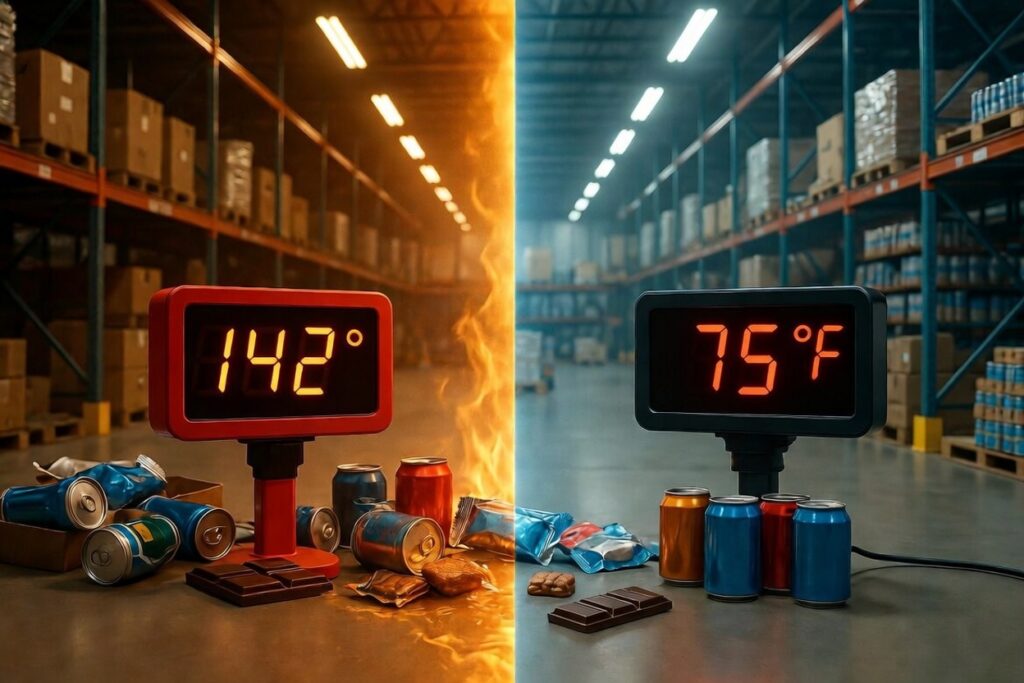
Your operations team just discovered another batch of premium products degraded in storage. The temperature logs show everything was “within acceptable range,” but acceptable isn’t good enough when your margins depend on product integrity. In Phoenix’s brutal climate, the gap between acceptable and optimal temperature control can cost millions.
Most food and beverage companies underestimate the true financial impact of temperature fluctuations. They focus on obvious spoilage losses while missing quality degradation, customer complaints, and the cascading costs that follow. When outside temperatures hit 120°F, standard warehouse systems struggle to maintain even basic climate control.
This article breaks down the hidden costs of “good enough” temperature management and shows how precise controlled ambient storage protects both products and profits in extreme heat environments.
The Hidden Price Tag of Temperature Swings
Temperature-related losses average 3-8% of revenue for food companies, but the real damage goes far beyond obvious spoilage. A 5-degree temperature swing that seems minor can trigger a cascade of expensive problems.
Consider the math: A beverage company shipping 10,000 cases monthly at $24 per case generates $240,000 in monthly revenue. A conservative 4% loss rate costs $115,200 annually. That’s before factoring in customer complaints, which cost 10 times more to resolve than prevention.
Arizona’s summer heat adds another layer of risk. Standard warehouses experience 15-20% higher spoilage rates during peak summer months when outside temperatures soar above 115°F. HVAC systems strain under the load, creating temperature spikes that compromise product integrity.
One beverage client avoided $2.3 million in annual product write-offs by switching from standard warehouse storage to our controlled ambient environment. The difference? Maintaining precise 65-75°F temperatures year-round, regardless of external conditions.
The costs compound quickly:
- Direct product losses from degradation
- Quality complaints requiring replacement shipments
- Brand reputation damage from inconsistent products
- Regulatory compliance issues and potential fines
- Insurance claims and higher premiums
What most operations teams don’t realize is that temperature problems rarely announce themselves. Products degrade gradually, quality complaints surface weeks later, and by then you’re dealing with systemic issues across multiple shipments.
Why Good Enough Temperature Control Fails in Arizona
Phoenix presents unique challenges that expose weaknesses in standard warehouse temperature management. When outside temperatures reach 120°F, maintaining even basic climate control becomes a battle against physics.
Traditional warehouses rely on HVAC systems designed for moderate climates. These systems struggle with extreme heat loads, leading to temperature swings that seem minor on paper but devastate sensitive products. A warehouse that maintains 78-82°F might seem acceptable, but that 4-degree range represents significant quality risk.
HVAC failures spike 40% during Phoenix summer months. When systems fail, internal temperatures can climb 10-15 degrees within hours. Products sitting in 95°F warehouses while repairs happen face immediate degradation risk.
Our 700,000 square foot facility demonstrates what’s possible with proper design. During the record-breaking 118°F heatwave last July, we maintained perfect 65-75°F controlled ambient conditions without interruption. The difference lies in redundant systems specifically engineered for extreme climate conditions.
Insurance companies recognize this reality. Claims for temperature-related losses increase dramatically during summer months, and premiums reflect the added risk. Companies using standard warehouse storage pay higher insurance rates because insurers understand the failure patterns.
The solution isn’t bigger HVAC systems. It’s purpose-built controlled ambient storage designed for extreme climates. When external temperatures fluctuate 40 degrees between night and day, you need systems that maintain precise internal conditions regardless of outside stress.
The Engineering Behind Climate Control
Controlled ambient storage requires more than powerful air conditioning. It demands comprehensive environmental management:
- Redundant HVAC systems with automatic failover
- Thermal mass design that resists temperature swings
- Insulation systems rated for extreme temperature differentials
- Backup power systems that maintain full climate control
- Predictive maintenance preventing system failures
Real-Time Visibility Prevents Expensive Surprises
Temperature problems discovered too late result in total product loss. The traditional approach of checking temperature logs after problems surface misses the window for corrective action.
Our AI Cargo Towers provide continuous monitoring with 15-minute alert cycles. When sensors detect even minor temperature drift, the system immediately notifies operations teams while automatically adjusting environmental controls.
This early warning system prevented a $180,000 product loss last month. A sensor detected a 2-degree temperature increase in one storage zone at 2:47 AM. The system sent instant mobile alerts to our operations team and automatically activated backup cooling. By 3:15 AM, temperatures returned to optimal range. Without real-time monitoring, that temperature spike would have compromised 12,000 cases of premium beverages.
Historical data provides another critical advantage. During customer audits or regulatory inspections, complete temperature records demonstrate compliance and due diligence. These records also identify patterns that predict system stress before failures occur.
The technology stack includes:
- Wireless sensors throughout storage zones
- Cloud-based analytics predicting system failures
- Mobile alerts with escalation protocols
- Historical reporting for compliance documentation
- Integration with warehouse management systems
Predictive maintenance represents the next evolution. Instead of reacting to failures, AI analyzes system performance data to schedule maintenance before problems develop. This approach eliminates surprise breakdowns during critical periods.
The Cost of Reactive vs. Proactive Monitoring
Reactive monitoring discovers problems after damage occurs. Proactive systems prevent problems before they start. The financial difference is substantial when you consider that temperature-related losses often affect entire product lots, not individual cases.
Scaling Temperature Control Without Breaking Budgets
Building temperature-controlled capacity requires massive capital investment. A controlled ambient facility costs $150-200 per square foot to construct, plus ongoing operational expenses for specialized systems.
Most food companies face a scaling dilemma: they need reliable temperature control to grow, but lack the capital to build dedicated facilities. Traditional 3PL providers offer basic climate control that fails during peak demand or extreme weather.
Our approach eliminates this capital barrier. Companies access controlled ambient storage from 3,000 to 100,000+ square feet without infrastructure investment. You pay only for space used while maintaining guaranteed temperature control.
Fairlife’s expansion illustrates this flexibility. They started with 3,000 square feet of controlled ambient storage for regional distribution. As demand grew, they scaled to 15,000 square feet, then 45,000, and eventually 100,000 square feet. Throughout this 30x growth, temperature control remained perfect because the infrastructure was already in place.
The economic advantage becomes clear during peak seasons. Instead of scrambling for overflow capacity that compromises temperature control, companies can immediately access additional space within the same controlled environment. No quality risks, no temperature variations, no rushed decisions that cost more later.
Capacity allocation works both ways. During slower periods, companies reduce their footprint without fixed facility costs. This flexibility proves especially valuable for seasonal products or companies testing new markets.
Financial benefits include:
- No capital expenditure for temperature control infrastructure
- Immediate access to controlled ambient capacity
- Scalable costs that match business growth
- Guaranteed temperature control regardless of facility size
- Shared infrastructure costs across multiple clients
The Hidden Costs of Building vs. Partnering
Building controlled ambient capacity ties up capital for 10-15 years. Partnering with specialized facilities preserves capital for core business growth while accessing best-in-class temperature control technology.
Making the Business Case for Precision Temperature Control
Operations teams often struggle to justify the premium for controlled ambient storage when standard warehouses seem adequate. The business case becomes clear when you calculate total cost of ownership.
Standard warehouse storage might cost $8-12 per square foot annually. Controlled ambient storage costs $15-18 per square foot. The $3-6 premium seems expensive until you factor in avoided losses.
A company storing $2 million worth of inventory monthly saves $80,000-160,000 annually by avoiding the typical 4-8% temperature-related loss rate. The controlled ambient premium costs $18,000-36,000 annually for 6,000 square feet. Net savings: $62,000-124,000 per year.
Quality complaints create additional hidden costs. Each complaint requiring product replacement costs 10x the original margin. Controlled ambient storage eliminates temperature-related complaints, protecting both immediate profits and long-term customer relationships.
Risk mitigation provides another layer of value. Insurance companies offer premium discounts for facilities with proven temperature control systems. Some retailers require controlled ambient storage for premium products, making it a market access requirement rather than optional upgrade.
Key Evaluation Criteria for Temperature-Controlled 3PLs
When evaluating controlled ambient storage providers, focus on operational capabilities rather than marketing promises:
- Redundant systems with automatic failover capability
- Real-time monitoring with immediate alert protocols
- Historical performance data during extreme weather events
- Flexible capacity allocation matching business growth
- Integration capabilities with existing supply chain systems
Red flags include providers who can’t demonstrate consistent performance during peak summer months, lack real-time monitoring systems, or require long-term capacity commitments that limit flexibility.
The difference between adequate and optimal temperature control determines whether you’re building a scalable distribution network or constantly managing product quality crises. In Phoenix’s extreme climate, there’s no middle ground.
Smart operations teams recognize that controlled ambient storage isn’t an expense – it’s infrastructure that enables growth. When temperature control becomes a competitive advantage rather than a cost center, you’ve found the right approach to scaling in challenging environments.
Frequently Asked Questions
Q: What makes controlled ambient different from regular warehouse storage?
A: Controlled ambient maintains precise 65-75°F temperatures year-round, unlike regular warehouses that fluctuate with outside conditions. This prevents product degradation while avoiding refrigeration costs.
Q: How do you maintain temperature control during Phoenix summers?
A: Our 700,000 sq ft facility uses redundant HVAC systems and continuous monitoring to maintain 65-75°F even when outside temperatures reach 120°F. We have backup systems that activate automatically.
Q: What happens if temperature control fails?
A: AI Cargo Towers provide 15-minute early warnings before problems occur. Our redundant systems and predictive maintenance prevent failures. If issues arise, you receive instant mobile alerts with our response plan.
Q: How much space do you need for controlled ambient storage?
A: We scale from 3,000 to 100,000+ sq ft based on your needs. Fairlife grew from 3,000 to 100,000 sq ft while maintaining perfect temperature control throughout their expansion.
Matt Dircks | Food & Beverage Logistics Specialist, Dircks Moving & Logistics
Frequently Asked Questions
What is controlled ambient food storage?
Warehouse space held at consistent, continuously monitored conditions year-round, suited to shelf-stable food and beverage.
Is Dircks a food-grade warehouse?
Yes. Dircks operates FDA-registered, food-grade warehouse space with documented sanitation procedures.
How is controlled ambient different from refrigerated storage?
Refrigerated storage serves cold-chain products. Controlled ambient suits shelf-stable goods that still degrade in uncontrolled heat.
