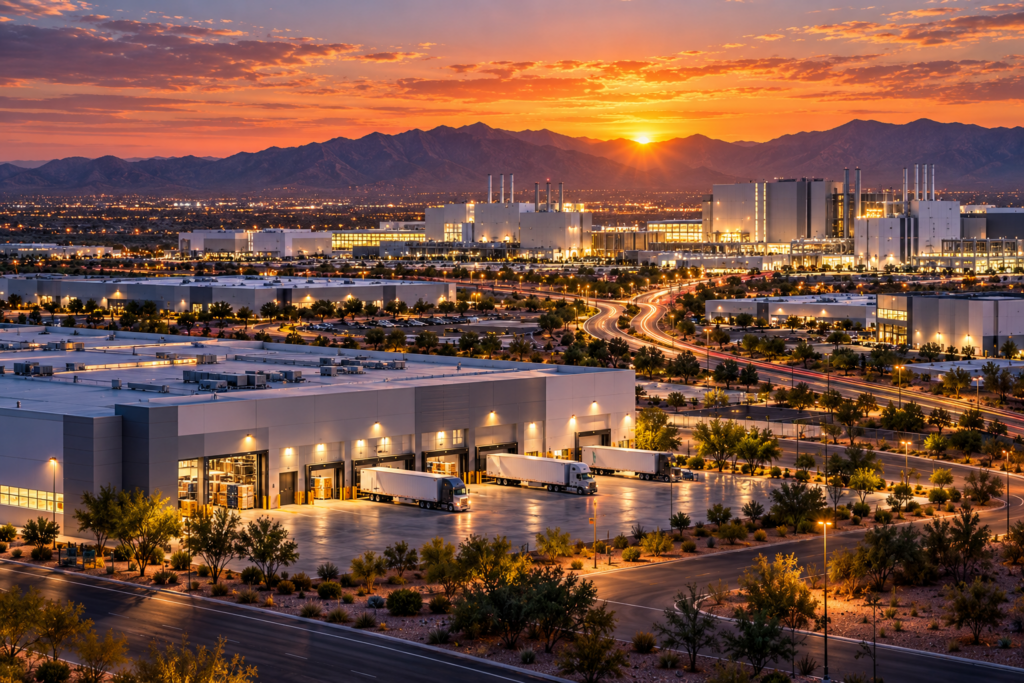
How Arizona’s Semiconductor Landscape Demands a New Logistics Strategy
Arizona’s chip corridor grew faster than most supply chains could adapt to it. TSMC and Intel expanded their fab footprints, pulling in dozens of suppliers who now need warehousing and logistics that match fab velocity, not the general freight playbook most 3PLs still run. Semiconductor logistics in Phoenix has become increasingly specialized, requiring a different approach to warehousing, transportation, inventory visibility, and time-sensitive delivery.
This article breaks down why Arizona’s semiconductor landscape demands a new logistics strategy, what most operations teams get wrong about proximity and integration, and how a bridge 3PL model closes the gap between fab timelines and warehouse capability.
Arizona’s Chip Boom Broke the Old Logistics Playbook
Arizona’s semiconductor ecosystem continues to expand. TSMC has announced plans that would bring its total U.S. investment to $165 billion, centered on its growing Arizona manufacturing presence, while Intel is investing more than $32 billion to expand and modernize its Ocotillo campus in Chandler. The suppliers supporting this ecosystem need logistics capable of handling high-value equipment, components, and other sensitive materials on schedules aligned with semiconductor manufacturing.
Logistics models designed for retail distribution or general manufacturing may not account for the timing, handling, visibility, and documentation requirements associated with semiconductor operations. Those relationships assumed forgiving delivery windows and freight that could tolerate a few days of slack. Fab production doesn’t work that way. A missed delivery window on a critical component can idle a production line that costs far more per hour than any logistics contract.
Semiconductor manufacturing can depend on tightly coordinated inventory and replenishment schedules. For critical materials and components, delivery timing may be measured in hours rather than days. A logistics operation supporting these environments needs the visibility and responsiveness to keep pace.
Distance compounds the problem. A 3PL located 45 minutes from a fab, dependent on interstate freight lanes prone to Phoenix traffic delays, introduces variability that fab schedulers can’t plan around. Dircks operates a 700,000-square-foot Phoenix facility positioned near Arizona’s growing semiconductor manufacturing corridor.
Suppliers entering the Arizona market should evaluate more than warehouse square footage. Fab proximity, semiconductor experience, systems integration, handling procedures, and the ability to scale should all factor into the decision.
Why Fab Proximity Isn’t a Nice-to-Have
Fab proximity isn’t simply about convenience. It’s about reducing response time and last-mile variability when inventory is needed quickly. A fab running 24/7 production schedules can’t absorb replenishment delays measured in hours, let alone days.
Traditional 3PL site selection weighs labor costs, highway access, and square footage pricing. Those factors matter, but they miss the core requirement for semiconductor suppliers: how fast can inventory move from warehouse to fab floor when a line-down call comes in.
Fab downtime costs are measured in hours, not days. When a critical component or material is unavailable, production delays can quickly become expensive. Reducing the distance between inventory and the fab can help shorten response times when urgent replenishment is needed. A 3PL sitting outside the immediate delivery radius introduces last-mile variability that fab schedulers have to build buffer time around, which defeats the purpose of just-in-time inventory in the first place.
Dircks’ Phoenix location was selected in part to provide close access to major semiconductor operations, helping reduce response time for time-sensitive deliveries. Closer proximity can also help reduce reliance on long-distance expedited transportation when urgent replenishment is required.
Traditional approaches fall short here because they treat all warehousing as interchangeable. Square footage and dock doors matter less than the minutes between your inventory and the production line depending on it.
The Approach: Bridge 3PL Built for Fab Timelines
Dircks’ semiconductor logistics model centers on three requirements: proximity, systems integration, and precision handling. We call this the bridge 3PL model, connecting fab-adjacent warehousing with the systems and processes semiconductor suppliers use to manage inventory and production requirements.
API-First Integration Removes the Manual Data Gap
Semiconductor suppliers often rely on complex enterprise systems to manage high-value inventory. When warehouse systems aren’t effectively integrated with those platforms, manual data entry and reconciliation can introduce delays and increase the potential for errors. For high-value semiconductor inventory, even small tracking errors can carry significant operational and financial consequences.
Our API-first WMS architecture is designed to synchronize inventory data with client systems and reduce reliance on manual reconciliation. Combined with AI Cargo Tower technology, it provides greater visibility into inventory location and status throughout the warehouse.
Controlled Ambient Storage Protects Sensitive Components
Semiconductor-related inventory can have specific requirements for temperature, humidity, electrostatic discharge protection, packaging, and handling. Those requirements vary by product, which makes it important for a 3PL to understand and document the appropriate storage and handling procedures before inventory arrives. Arizona’s extreme summer heat makes consistent environmental controls especially important for inventory with defined storage requirements.
Dircks maintains consistent, continuously monitored controlled ambient storage across our full 700,000 square foot footprint, year-round, regardless of what’s happening outside. Together, these measures help maintain appropriate storage conditions and support consistent handling from receipt through outbound delivery.
Practical Takeaways for Evaluating a Semiconductor 3PL
Operations VPs and supply chain directors evaluating logistics partners in Arizona’s chip corridor should look for specific capabilities, not general reassurances.
- Fab proximity measured in minutes, not miles. Ask exactly how far the facility sits from your production site and what response time looks like for urgent replenishment.
- API-first WMS integration. Ask how the 3PL’s WMS connects with your existing systems, what information can be exchanged, and where manual processes may still be required.
- Controlled ambient storage with documented monitoring. A vague claim of climate control is not enough. Ask how conditions are monitored and logged year-round.
- Handling protocols specific to sensitive components. Ask what training, ESD controls, and documented handling procedures are available for the specific inventory you plan to store.
- A growth model, not a fixed contract. Your space and volume requirements may change as production demand evolves. Your logistics partner should be able to scale with you without a full contract renegotiation.
The goal is to understand exactly what a potential 3PL can support today and how its capabilities align with your future requirements. Specific answers about location, systems, environmental controls, handling procedures, and scalability are more valuable than general assurances.
Conclusion
Arizona’s semiconductor boom rewrote the requirements for logistics partners in this market. For suppliers supporting time-sensitive semiconductor manufacturing, proximity, systems integration, inventory visibility, and appropriate handling procedures can all play an important role in reducing logistics risk. Dircks supports semiconductor logistics from its Phoenix operation with scalable warehouse capacity, systems integration capabilities, controlled ambient storage, and proximity to Arizona’s semiconductor corridor.
Arizona’s semiconductor ecosystem continues to develop as major manufacturers expand their local operations and additional suppliers establish a presence around them. Logistics providers supporting that ecosystem will need the infrastructure, technology, and processes to adapt alongside it.
If you’re evaluating your current semiconductor logistics strategy or planning for future growth in Arizona, understanding these capabilities is a good place to start.
Learn more about our
semiconductor logistics services or
contact the Dircks team to talk through your requirements.
Frequently Asked Questions
What is a bridge 3PL for semiconductor suppliers?
Dircks uses the term “bridge 3PL” to describe a logistics model designed to connect fab-adjacent warehousing with the systems, inventory visibility, and handling processes semiconductor suppliers need. The approach centers on proximity, integration, and appropriate handling procedures.
Why does fab proximity matter so much in Phoenix?
Close proximity can reduce transportation time and last-mile variability when urgent replenishment is required. For suppliers supporting time-sensitive production schedules, that responsiveness can be an important part of the overall logistics strategy.
What should a chip supplier ask a 3PL before signing?
Ask for the exact distance and response time to your fab, ask how the WMS integrates with your existing systems and what information can be exchanged automatically.
 Skip to content