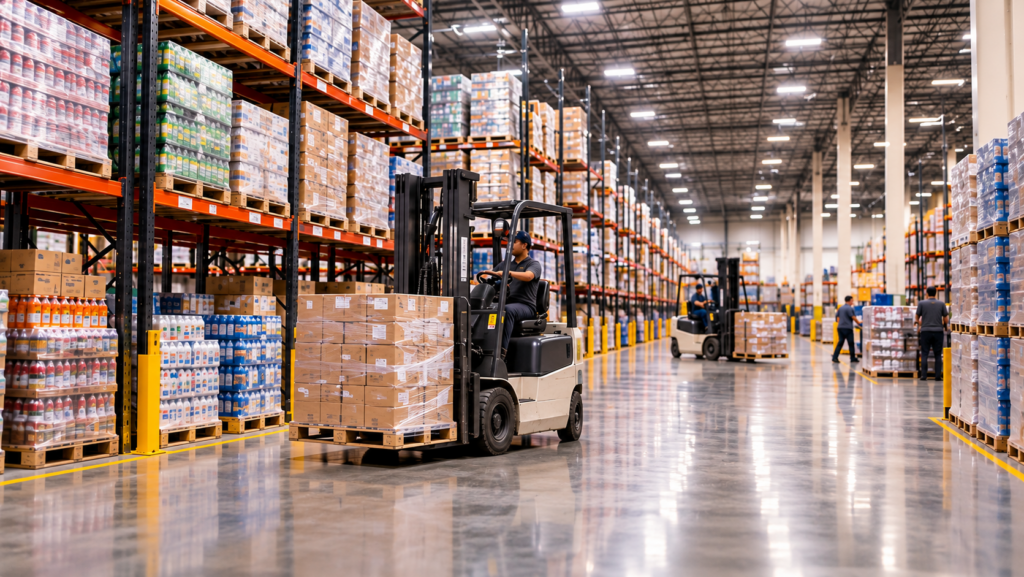
Scaling CPG Distribution in the Southwest
CPG brands expanding into the Southwest often plan their distribution strategy using assumptions built for other markets. But what works in Ohio or New Jersey may not translate directly to Phoenix.
Arizona heat, sprawling metro geography, and the demands of rapid growth create a different set of challenges for food, beverage, and consumer packaged goods brands.
For supply chain teams evaluating warehouse space in Arizona, the decision goes well beyond square footage. Product requirements, inventory visibility, retailer expectations, and future growth all need to factor into the equation.
Here’s what growing CPG brands should consider when evaluating a Phoenix 3PL and building a distribution strategy designed to scale.
Why Southwest Growth Can Challenge Distribution Plans
CPG brands expanding into Arizona can run into problems when they assume the same warehouse strategy that worked in another market will work here, or when they underestimate how quickly their space requirements may change.
Arizona summers regularly bring extreme heat. For products with specific environmental requirements, that makes storage conditions an important consideration. A warehouse needs to do more than simply provide space. It needs to maintain the conditions required by the products stored inside.
Geography adds another layer. The Phoenix metro covers a large footprint, making warehouse location an important part of delivery planning. A distribution center located far from key customers or retail distribution corridors can add time and complexity to delivery routes.
Then there is growth.
Some warehouse agreements are structured around fixed space allocations. That can become a challenge when a brand grows faster than expected. A company that starts with 10,000 square feet may eventually need significantly more, raising questions about whether it can expand within the same facility or needs to renegotiate, relocate, or split inventory between locations.
Dircks operates a 700,000-square-foot facility designed to provide room for customers to scale. For growing CPG brands, that capacity can make it possible to expand within an existing warehouse relationship as volume increases.
Common Misconceptions About Phoenix Warehousing
- Assuming any warehouse with air conditioning provides the environmental controls your products require
- Prioritizing proximity to Phoenix Sky Harbor without considering customers and retail distribution corridors
- Focusing only on current space requirements instead of planning for future growth
- Assuming all CPG products have the same storage and handling requirements
Controlled Ambient Storage and Product Quality
Controlled ambient storage is designed to maintain products within defined environmental conditions rather than allowing warehouse temperatures to fluctuate significantly with outside conditions.
The appropriate conditions depend on the product and its specific storage requirements.
For products that do not require refrigeration but still have defined environmental needs, consistent conditions can be especially important in a desert climate. Certain beverages, shelf-stable goods, and other temperature-sensitive CPG products may be affected by prolonged exposure to excessive heat or significant temperature fluctuations.
Dircks maintains continuously monitored controlled ambient conditions within its facility, supporting products that require greater environmental consistency without requiring refrigerated storage.
When appropriate storage conditions are not maintained, the consequences can extend beyond the warehouse. Product degradation can contribute to returns, rejected shipments, retailer compliance issues, and shortened shelf life.
The important distinction is not simply whether a warehouse has air conditioning. CPG brands should understand the conditions their products require and verify that a potential 3PL can maintain, monitor, and document those conditions consistently.
Real-Time Visibility Without the ERP Headache
One of the biggest concerns operations teams can face when switching 3PLs is maintaining inventory visibility throughout the transition and after inventory moves into a third-party facility.
Without a clear integration plan, teams may struggle to get timely information about inventory levels, order status, and product movement.
Dircks approaches visibility through its warehouse technology and WMS integration capabilities. AI Cargo Tower technology tracks inventory movement throughout the facility, providing real-time visibility into product location and status. API-first WMS integration can also connect with existing ERP environments while reducing the need for manual reconciliation.
For CPG brands, that visibility matters.
Stockouts can affect product availability and retailer relationships. Excess inventory ties up capital and increases storage requirements. Timely inventory information gives operations teams the visibility they need to identify potential issues earlier and make more informed decisions.
What 3PL Integration Should Look Like
When evaluating a provider’s technology, look for:
- A clearly defined integration path between the 3PL’s WMS and your existing ERP
- Real-time inventory tracking rather than relying solely on end-of-day updates
- Timely visibility into shipment status without depending on manual requests for routine information
- A clear implementation and testing process before inventory begins moving
Technology should make managing your supply chain easier, not create another layer of work for your team.
Built to Scale With You
Warehouse requirements rarely stay static for a growing CPG brand.
The question isn’t only whether your 3PL has enough space today. It’s whether it has the capacity and operational flexibility to support where you’re headed next.
Fairlife provides a strong example of what scalable warehouse capacity can look like in practice. Its footprint with Dircks grew from approximately 3,000 square feet to more than 100,000 square feet within the warehouse relationship. \
Growth at that scale requires more than unused square footage. A 3PL needs the operational flexibility to allocate additional space as volume changes while maintaining the processes, visibility, and service its customer already relies on.
Dircks’ 700,000-square-foot facility provides capacity that can support customers as their storage needs evolve. Rather than evaluating only how much space a 3PL can provide today, growing brands should understand how that provider plans to accommodate tomorrow.
Dedicated account management matters here, too. As a brand grows from relatively small pallet counts to a much larger operation, having a consistent point of contact who understands the product, retailer requirements, and growth trajectory can help maintain continuity as needs change.
What to Ask When Evaluating a Phoenix 3PL
Choosing a Phoenix 3PL for CPG distribution requires looking beyond square footage and price per pallet.
Start with these questions:
- How are storage conditions maintained and monitored? Know the conditions your products require, then ask how the 3PL maintains, monitors, and documents them throughout the year.
- What happens when we need more space? Understand how the provider accommodates significant growth and whether additional capacity can be added within the existing relationship.
- How will your WMS connect with our systems? Ask about the integration process, expected timeline, testing requirements, and responsibilities on both sides.
- Can you show us an example of a customer that scaled with you? A real growth example can show how the provider handles changing space and operational requirements.
- Where is the facility relative to our distribution network? Consider customers, retail distribution corridors, transportation routes, and delivery requirements.
- Who will manage our account as we grow? Understand how communication and account management will change, or remain consistent, as your operation expands.
The goal is to determine whether a 3PL can support not only your current volume but also the changes that come with growth.
Conclusion
Scaling CPG distribution in the Southwest brings challenges that may look different from those in other markets. Arizona heat, a sprawling metro area, changing space requirements, and complex distribution networks all need to factor into warehouse planning.
For brands with temperature-sensitive products and ambitious growth plans, consistent environmental controls, reliable inventory visibility, and flexible space allocation can help reduce the operational challenges that come with scaling.
Fairlife’s growth from approximately 3,000 to more than 100,000 square feet with Dircks demonstrates what scalable warehouse capacity can support. If your brand is evaluating distribution partners in Phoenix, look beyond today’s square footage requirement.
Ask how storage conditions are monitored. Ask how systems integrate. Ask what happens when your volume doubles or triples.
The right 3PL relationship should support where your business is headed, not just where it is today.
Learn more about our
food and beverage logistics services or
contact the Dircks team to talk through your requirements.
Frequently Asked Questions
Why can scaling CPG distribution be more challenging in the Southwest?
Arizona’s extreme summer temperatures, the large geographic footprint of the Phoenix metro, and changing warehouse requirements as brands grow can add complexity to distribution planning. Companies should consider environmental requirements, location, transportation needs, technology, and future capacity when evaluating a 3PL.
What is controlled ambient storage and why does it matter for CPG products?
Controlled ambient storage is designed to maintain defined environmental conditions rather than allowing warehouse temperatures to fluctuate significantly with outside conditions. For certain beverages, shelf-stable goods, and other products with specific storage requirements, maintaining consistent conditions can help protect product quality and shelf life.
How should a growing brand evaluate a Phoenix 3PL?
Look beyond current square footage and price. Ask how storage conditions are monitored and documented, how the WMS integrates with your existing systems, how additional space is allocated as your business grows, and whether the provider can demonstrate experience supporting customers through significant growth.
 Skip to content